
Why I Started FloatR
I ran a clinical lab. And if you've ever run one, you already know the problem I'm about to describe.
Every morning started the same way: checking who was scheduled to draw blood, who had called out, and which client site was about to go uncovered. Phlebotomists and specimen collectors are the backbone of diagnostic testing. Without them, samples don't get collected, tests don't get run, and patients don't get answers. Yet finding and scheduling them was, without exaggeration, one of the hardest parts of running my business. Agencies were slow and expensive. Job boards produced candidates who vanished after one shift. Spreadsheets and group texts held together a system that broke every time someone got sick or a new account signed on.
I built the first version of what became FloatR to solve my own problem: I needed a faster, more reliable way to find qualified collectors and get them scheduled, credentialed, and covering shifts, without waiting on an agency or hoping someone answered a text.
But the more I built, the more I realized the opportunity was bigger than fixing my own scheduling headache.
Healthcare is short more than 4 million credentialed workers nationwide, and phlebotomy and specimen collection sit right in the middle of that shortage. At the same time, there's a generation of trained, credentialed healthcare workers who don't want, or can't take, a traditional, fixed-schedule job. Pre-med students building clinical hours. Parents who need to work around school pickup. Experienced phlebotomists who'd rather pick up shifts across multiple facilities than commit to one employer's calendar. The traditional staffing model wasn't built for any of them.
That's the real reason FloatR exists. It's not just a tool for labs like the one I used to run. It's a platform that gives healthcare workers real control over their careers. Set your own availability. Build your credentials once and use them everywhere. Pick up a shift across town or across the state. Get paid on time, every time. In return, healthcare facilities get access to a nationwide pool of pre-vetted, credentialed professionals who show up, without ever calling an agency.
We now call the people who work shifts through our platform “FloatRs,” and there are more than 18,000 of them across the country. They're the reason FloatR works at all, so building a real community with them, not just a marketplace, matters to me.
Meeting Our FloatRs in Person
A few weeks ago, we hosted our first FloatR Happy Hour in New Jersey, an informal evening to meet some of the FloatRs who've been working shifts through the platform, many of them for the first time in person.
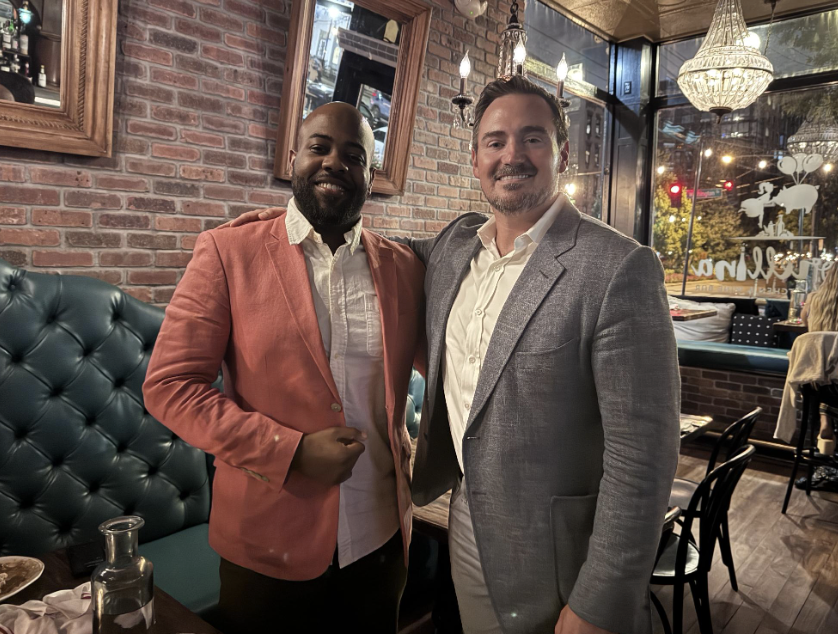
Conversations like these are why we built this in the first place. Hearing directly from the people using FloatR, what's working, what's frustrating, what a good week of shifts actually looks like for them, shapes almost everything we build next.
What FloatRs Are Telling Us
We recently ran an NPS survey across our FloatR community, and the results reinforced what we're hearing in person: an average score above 8. More than the number, it's the comments that stuck with me.
One FloatR, a pre-medical student, told us:
“As a pre-medical student, FloatR was my first clinical experience and provided an excellent foundation for me in healthcare and I developed valuable patient care and phlebotomy skills. I would definitely recommend it to others.”
Another described the day-to-day experience of the platform itself:
“The FloatR app was extremely easy to create my profile, upload credentials, have my interview and find a location that needed coverage. Punching in is extremely easy. Any time I've needed support, I've been able to chat with someone right inside of the app and I'm always paid on time. I've never had an issue, I am extremely satisfied and would recommend!”
A few others summed up why FloatR works so well for people building a career in the field:
“Yes, FloatR is an excellent way to learn and gain professional experience on whatever the field someone evolves.”
“Amazing communication and contracts and they work with your schedule.”
And one comment captured something we hope every FloatR feels:
“I love this company and the community of people who now I consider part of family.”
The Road Ahead
I started FloatR because I couldn't find enough qualified phlebotomists to cover my own lab's shifts. I ran that lab myself, so I know every scheduling gap FloatR fixes firsthand. What I've learned since is that the fix for that problem and the fix for the healthcare workforce shortage are the same thing: give skilled people control over how, when, and where they work, and the coverage follows.
We're just getting started. If you're a lab or healthcare facility that's tired of chasing agencies, or a credentialed professional who wants to work on your own terms, I'd love for you to see what we've built.